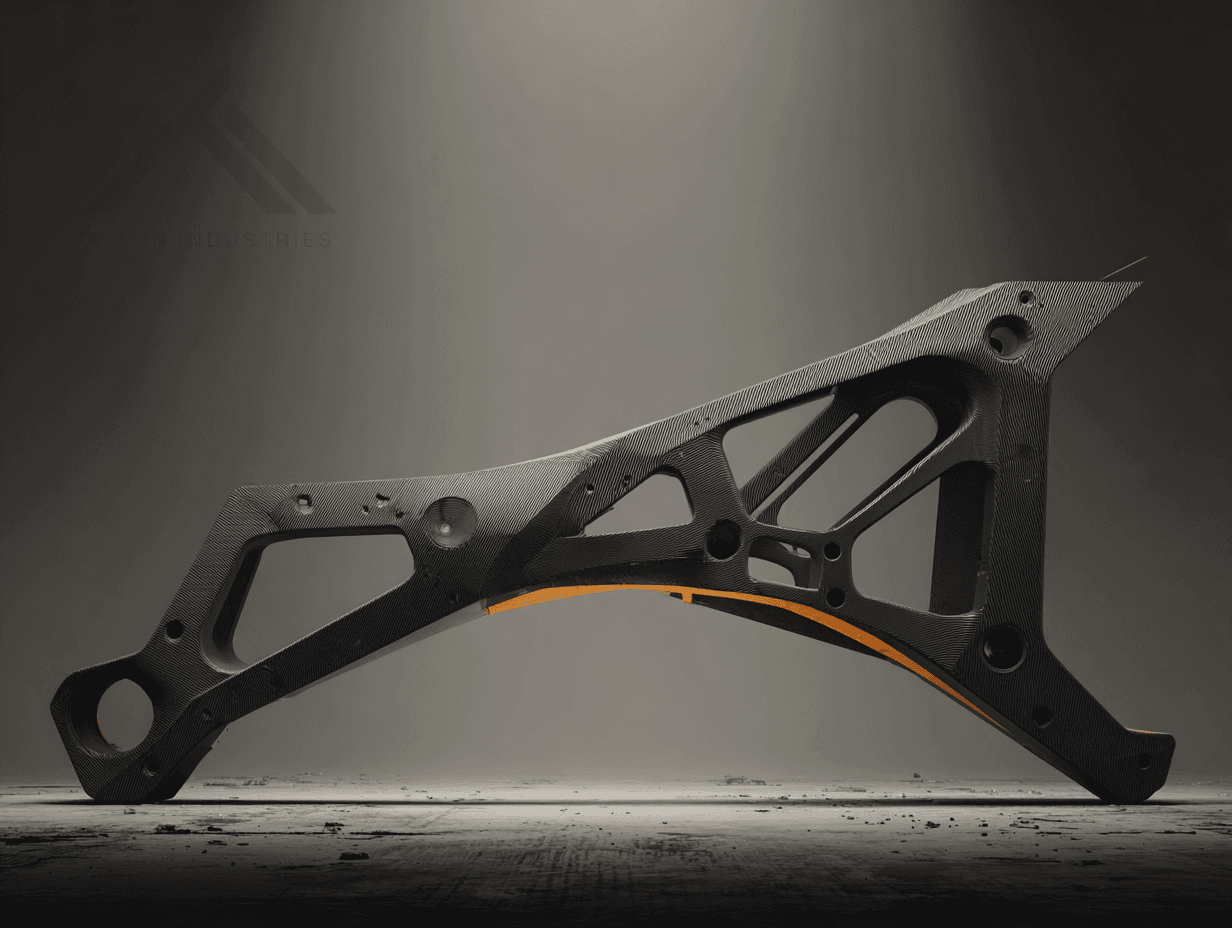
From the soft jaw a machinist needs by Friday to the production-floor fixture the OEM won't quote under three weeks. Quoted same business day. No sales layer — you work with the engineer who quotes the job, runs the parts, and answers the call.

Five categories of shop-floor work where additive ships better than the alternative.
Soft jaws, custom workholding, and fixture stand-ins — in your hands faster than the next setup demands them.
Soft jaws · Vise jaws · CMM fixtures · Setup blocks · Custom workholding
See machining capabilities →Weld fixtures, alignment jigs, and inspection gauges — built for the run you're on, not the run someone budgeted for last year.
Weld fixtures · Alignment jigs · Drill guides · Inspection gauges · Tack-weld locators
See weld & fab capabilities →Trim fixtures, packaging nests, and gauges that hold tolerance after the press runs — without machined-aluminum lead times.
Trim fixtures · Packaging nests · Pick-and-place trays · Insert positioners · Inspection gauges
See injection molding capabilities →End-of-arm tooling, line-side fixtures, and ergonomic aids — engineered for the operator who'll actually use them.
EOAT plates · Vacuum cups · Line-side fixtures · Ergonomic aids · Pick stations
See assembly & EOAT capabilities →Replacement parts the OEM no longer stocks — guards, brackets, and consumables printed in engineering thermoplastics, in service the next morning.
Replacement bushings · Custom guards · Discontinued OEM parts · Cable management · Sacrificial wear components
See maintenance capabilities →For more than a decade, the technology that prints the fixtures, tooling, and production parts on the world's most advanced manufacturing floors has lived behind a $40,000 minimum and a multi-year service contract. Aerospace, automotive, defense, heavy equipment — GE, Boeing, SpaceX, Honeywell, BMW, Bosch, John Deere. Every Tier-1 manufacturer worth naming has been running engineering-thermoplastic FDM to build the production tooling that keeps their lines moving.
The technology was never secret. The capital was the gate.
For a 400-person manufacturer, $40,000 to $100,000 per machine was a sourcing committee, a capital request, and a year of internal politics. For a 10-person shop, it was a number to laugh at. What separated the Fortune 500 from everyone else wasn't capability. It was capex.
We run the same engineering thermoplastics — carbon- and glass-reinforced polyamides, PPS-CF, PC-FR — on industrial-grade FDM, contract-manufactured for the operational tempo of your floor. Same capability. The capex isn't yours.
We operate a graduated production schedule. Service tier is selected at quote based on the customer's operational requirement. Tier capacity is reserved before tier commitments are made.
Available within the 30-mile metro radius for emergency production-line interruptions. Capacity reserved on a per-call basis — call to confirm availability before file submission.
Production completes within one business day. Parts available the following morning for files received during business hours. Available across the 100-mile corridor.
Production completes within two to three business days. Available throughout the operating region. Economy pricing for non-urgent work.
Most shops run fewer fixtures than they should. Not because the value isn't there — because at machine-shop pricing, a fixture that saves two seconds per cycle or one percent of scrap doesn't justify the machinist hours to build it. So it doesn't get built. At FDM pricing, the math changes.
A fixture that shaves two seconds per cycle, run 500 times a day by one operator over a working year, frees 70 hours of direct labor. That's a week of capacity back.
A fixture that cuts scrap by one percent on a line running 125,000 parts a year saves 1,250 parts annually — material, labor, and the cycle time to remake them.
One printed fixture preventing half a day of unplanned downtime on a $1,200/hour shop is $4,800 recovered. The fixture costs a fraction of that.
Large engineering organizations have invested substantial capital — purpose-built machines, multi-year service contracts, proprietary filament supply — to run industrial additive manufacturing on their own production floors. The cases below are theirs. The work is real. The economics are documented.
We operate the same engineering thermoplastics on industrial-grade FDM. Same material classes — carbon- and glass-reinforced polyamides, PPS-CF, PC-FR. Contract-manufactured for the Kansas City corridor. Without the capital outlay. Without the lock-in.
Build products. Don't burn capital.
For one-off jobs, legacy parts, or customer-supplied components you don't have a model for — we come to you with an EinScan Rigil Lite, capture the geometry on-site in minutes, and print straight from the scan data. Most contract printers can't do this. We can.
STEP, IGES, or STL. A sketch with critical dimensions works for one-offs. For legacy parts without CAD, on-site 3D scanning is available via the EinScan Rigil Lite.
Request an NDA before submitting files →Quote returned within one business day with material recommendation, manufacturing approach, service-tier options, and pricing.
Approved orders enter production at the selected service tier. Local pickup in Lenexa, courier delivery across the metro, or shipping nationwide.
We return a quote with material recommendation, manufacturing approach, service-tier options, and pricing within one business day. Owner-operated — the engineer who quotes a job is the one who runs it.