FDM that holds tolerance,
survives heat,
and ships on time.
Carbon- and glass-reinforced nylons (PA6, PA12, PA612, PAHT, PPA), PPS-CF for coolant-flooded work, PC and PC-FR, ASA-CF for outdoor use, PET family, ESD grades, and TPU. Real engineering parts. Real tolerances. Real lead times.
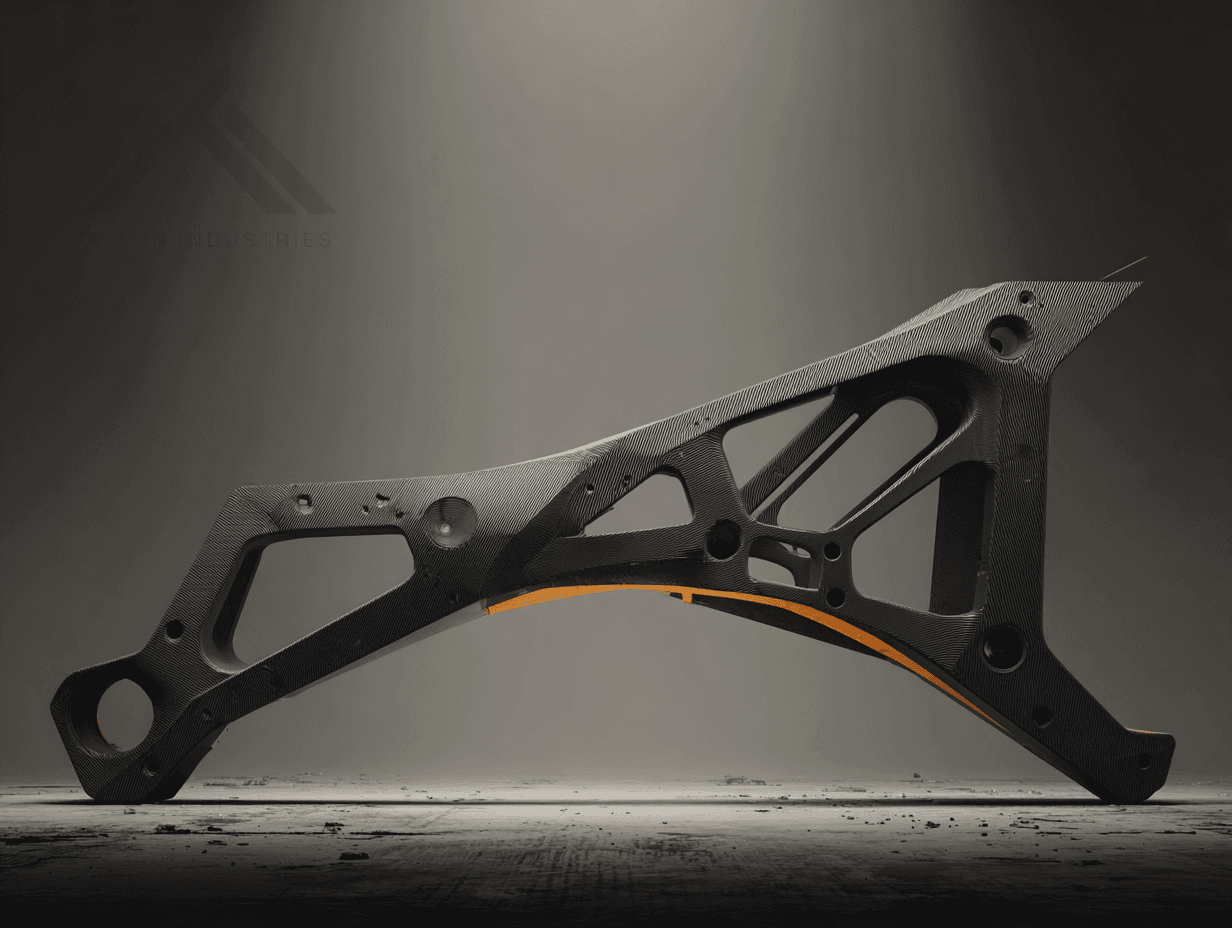
Layer-by-layer
thermoplastic deposition.
FDM (fused deposition modeling) builds parts by melting thermoplastic filament and depositing it layer by layer. It's the fastest way to get small-batch functional parts in real engineering thermoplastics in your hands.
Where FDM wins
Engineering thermoplastics — carbon-filled nylons, polycarbonate, ASA, PPS — at a fraction of hard tooling cost.
Multi-material assemblies — combine rigid structural plastic and flexible TPU in a single print.
Speed — most parts ship within 24 hours of an approved STEP file.
Iterability — change a dimension, reprint in hours, not weeks.
Where FDM doesn't win
Smooth cosmetic surfaces out of the printer. Layer lines are visible. We can sand or vapor-smooth (ABS/ASA), but if you need a flawless, glass-smooth finish out the door, FDM isn't your process.
Sub-±0.05 mm tolerances. FDM holds ±0.1–0.2 mm reliably. Tighter than that, you want CNC.
Optical clarity, very fine features under 0.3 mm, food-contact, FDA, or aerospace flight-critical parts. Different processes, different shops. We'll tell you when to use someone else.
No CAD file? We'll come scan it on-site →
Engineering thermoplastics,
not hobbyist filaments.
We run materials with mechanical, thermal, and chemical performance specified to engineering datasheets. If your part needs to survive heat, chemicals, or repeated mechanical load, we have the right material — or we'll tell you when something else is the right answer.
Production
Engineering thermoplastics from established industrial suppliers — suitable for the vast majority of fixtures, tooling, and shop-floor work.
Production+
US-manufactured equivalents with tighter batch tolerances and a Certificate of Conformity per spool — for jobs that require documented sourcing or material consistency.
Toughness, fatigue resistance, high cycle count.
| Material | Use it for | Key property | Skip it when |
|---|---|---|---|
| PA612-CF15 Carbon-fiber PA612 | Direct equivalent to Stratasys FDM Nylon 12CF for most applications. Structural brackets, jigs, drone arms, EOAT. | Lower moisture sensitivity than PA6 or PA12. Excellent stiffness-to-weight. | Repeated hard impact — fiber matrix is stiff but less impact-tolerant than unfilled PA. |
| PA612-ESD Electrostatic-dissipative PA612 | Electronics handling, PCB fixturing, anti-static parts trays. | PA612 backbone with conductive additive. Surface resistivity in the dissipative range. | Non-ESD applications — cost premium isn't justified. |
| PA6 Unreinforced nylon | Maximum toughness and impact resistance. Living hinges, snap fits, parts that take drops. | High elongation, excellent fatigue life. | Tight tolerances on large parts — moisture absorption causes dimensional drift over time. |
| PA6-GF20 / GF25 Glass-fiber PA6 | Stiffness-critical parts where carbon's cost isn't justified. | Higher stiffness than unreinforced nylon, retains fatigue resistance. | Conductive applications — glass fibers are insulating. |
| PA6-CF20 Carbon-fiber PA6 | Higher stiffness-to-weight than glass-filled. Functional brackets, structural jigs. | High modulus. PA6 toughness with CF stiffness. | Humid environments — PA6 absorbs more moisture than PA12 or PA612. |
| PA12-CF10 Carbon-fiber PA12 | Dimensionally stable parts in humid environments. Outdoor-adjacent applications. | Lower moisture pickup than PA6. | Sub-100 °C continuous-service applications where PA612-CF would cost less. |
| PAHT-CF High-temp nylon CF | Parts near heat sources — welding fit-up jigs, fixtures adjacent to hot zones. | Continuous service to ~150 °C. | Cost-sensitive room-temp work — use PA612-CF instead. |
| PPA-CF Polyphthalamide CF | Highest continuous-service temp in our nylon lineup. Sustained 150–180 °C exposure. | Continuous service to ~180 °C. CF stiffness. | Anything PAHT-CF handles — PPA-CF costs more. |
For coolant-flooded operations, solvents, and sustained heat.
| Material | Use it for | Key property | Skip it when |
|---|---|---|---|
| PPS-CF10 Polyphenylene sulfide CF | Coolant-flooded turning fixtures, wet-machining workholding, harsh chemical environments. Pump housings, fluid manifolds. | 486.5 °F (252.5 °C HDT). Chemically inert to standard machine shop coolants, solvents, cutting oils, acids, bases. Post-print annealed for full mechanical performance. | Cost-sensitive routine parts — material is expensive. Use PA-CF when chemistry isn't the constraint. |
| PPS-GF20 Glass-fiber PPS | Same chemical resistance as PPS-CF with a different stiffness profile and lower cost. | 486.5 °F (252.5 °C HDT). Insulating where carbon would conduct. | Stiffness-critical structural parts — use PPS-CF. |
Strong, dimensionally stable, impact-resistant.
| Material | Use it for | Key property | Skip it when |
|---|---|---|---|
| PC Polycarbonate | Welding fit-up jigs in moderate heat zones, structural workholding, parts that need impact resistance. | HDT ~138 °C. Highest impact strength of any common FDM thermoplastic. | UV exposure (yellows over time) — use ASA-CF outdoors. |
| PC-FR Flame-retardant PC | Electrical enclosure components, control housings, applications requiring UL94 flame ratings. | PC mechanicals plus UL94 flame rating. | Non-regulatory applications — standard PC costs less. |
For fixtures exposed to sun or weather.
| Material | Use it for | Key property | Skip it when |
|---|---|---|---|
| ASA-CF08 UV-stable ASA with carbon-fiber | Outdoor fixtures, sun-exposed parts, weather-exposed brackets. Both UV-stable and structurally rigid. | UV-stable. CF-reinforced — materially different from standard ASA. | Indoor structural work where PET-CF or PA-CF would be cheaper. |
General-purpose engineering workhorses.
| Material | Use it for | Key property | Skip it when |
|---|---|---|---|
| PET-CF17 Carbon-fiber PET | Workhorse material for general fixture work. Stiff, dimensionally stable, good chemical resistance to non-aggressive shop fluids. | High modulus. Good chemical compatibility. | Coolant-flooded immersion — use PPS-CF. |
| PET-GF15 Glass-fiber PET | Lower-cost alternative to PET-CF where carbon's stiffness premium isn't required. | Slightly lower stiffness than PET-CF, similar dimensional stability. | Stiffness-critical parts. |
| PETG-CF Carbon-fiber PETG | Lighter-duty engineering fixtures. Easier to print than PET-CF. | Stiff for PETG family, lower performance ceiling than PET-CF. | Fatigue-loaded parts — use PA-CF. |
| PETG-ESD Electrostatic-dissipative PETG | Cost-effective electronics handling fixtures, parts trays. | ESD-safe. | Structural applications — PA612-ESD performs better. |
| PETG-rCF08 Recycled-CF PETG | Cost-sensitive applications where sustainability is a value-add. | Recycled carbon-fiber feedstock. | Performance-critical work — virgin CF compounds perform more consistently. |
Soft-grip, non-marring, vibration-dampening.
| Material | Use it for | Key property | Skip it when |
|---|---|---|---|
| TPU 85A–95A Thermoplastic polyurethane | Soft-grip fixtures, paint-mask fixtures, non-marring workholding for finished parts, vibration-dampening pads, gaskets. | Flexible, abrasion-resistant. Co-prints with rigid plastics. | Parts needing full elastic recovery — TPU has some hysteresis. |
Multi-material: up to 24 channels in a single build. Combine rigid structural plastic with TPU gaskets, or co-print breakaway support material for complex internal geometries.
Need something not listed? Any compatible engineering filament can be sourced overnight. We'll tell you up front if a job is better served by a Stratasys-tier shop running PEEK, PEKK, or PEI/ULTEM — those exceed what we run in-house. See the limits of FFF for the full process boundary.
What we can build,
how big, how fast.
| Spec | Value | Notes |
|---|---|---|
| Build envelope | 340 × 320 × 340 mm (13.4 × 12.6 × 13.4 in) | Per machine. Larger parts via multi-print assembly. |
| Layer height | 0.1 – 0.3 mm | 0.2 mm typical. 0.1 mm for fine surface; 0.3 mm for speed. |
| Nozzle size | 0.4 mm / 0.6 mm hardened | Larger hardened nozzle used for carbon-filled and high-temp materials to reduce shear and abrasion. |
| Multi-material | up to 24 channels | Multi-color and multi-material in one build. |
| Tolerance | ±0.1 – 0.2 mm typ. | Geometry- and material-dependent — see Section 04. |
| Wall thickness | 0.4 mm minimum | 1.2 mm recommended for load-bearing surfaces. |
| Turnaround | Instant quote, next-day pickup | Typical for parts under 24-hour print time. |
Larger parts, multi-print assemblies, or tighter tolerances — talk to us →
What we can guarantee.
What we can't.
FDM is a real engineering process. It's not magic. Here's exactly what to expect.
Dimensional accuracy
±0.1 mm on small parts under 50 mm. ±0.2 mm on parts up to 200 mm.
Larger parts: dimensional drift in the build direction increases with part height. Worth a conversation before committing to a 300 mm-tall part with a tight bore.
Carbon-filled and glass-filled materials hold tolerance better than unfilled — anisotropic shrinkage is lower.
Anisotropy
FDM parts are not isotropic. Layer adhesion in the Z axis is roughly 60–80% of in-plane strength, depending on material and chamber temperature.
If your part takes load perpendicular to the print direction, design for that — orient the part so layer lines run with the load, or talk to us about reinforcement strategies.
Inspection & QC
We dimensionally check critical features with calipers, pin gauges, and — when geometry warrants it — the EinScan Rigil Lite for non-contact dimensional verification of complex surfaces and as-printed-vs-CAD comparison.
We don't operate a CMM in-house. If your application requires a full first-article inspection report or PPAP-grade documentation, tell us up front — we'll scope the inspection separately or refer you to a metrology shop.
What we don't do
Aerospace flight-critical certified parts. Medical implant or food-contact applications. ISO 9001 / AS9100 certified production.
If your spec requires certification we don't have, tell us — we'll either find you a partner or tell you we can't help. Honest answer beats wasted time.
From print
to finished part.
FDM parts come off the printer with visible layer lines, support marks, and minor surface texture. Depending on the application, that's fine as-is — or we finish.
As-printed
Standard. Layer lines visible. Best for jigs, fixtures, internal parts, structural parts where surface doesn't matter.
Support removal
All support material removed before delivery. No raft, no obvious blemishes.
Sanding & smoothing
Hand-sanded for cosmetic faces or where the part needs a smooth contact surface. Adds 1–2 days to lead time depending on part complexity.
Vapor smoothing
Available for ABS and ASA (acetone-vapor process). Produces a smooth, glossy surface finish. Adds 1–2 days and additional cost — specified on the quote.
Threaded inserts
Heat-set brass inserts, M2–M6, installed in-house. Specify in your request.
Post-print annealing
We anneal PPS-CF (and other semi-crystalline materials when called for) to complete crystallization, lock in dimensional stability, and unlock the full mechanical performance the datasheet promises. Specify on the request if your application demands it.
Painting & coating
We don't paint or coat in-house. We can recommend a local finisher.
What we make,
for whom.
Send the file. Get a price and a date.
Done.
Send the file
STEP, STL, or 3MF. STEP is preferred for tolerance-critical work — STL loses geometry information. A sketch with dimensions also works for one-offs.
Tell us what matters
Material preference (or ask us to recommend), quantity, deadline, post-processing needs (threaded inserts, sanding), tolerance requirements on critical features.
Instant quote
We email you a price and a delivery date instantly upon upload.
Approve and we invoice
New customers pay the invoice (ACH, credit card, or company PO) before we print. Established customers — Net 30 available. Larger jobs may require a deposit; we'll specify on the quote.
Pickup or delivery
Local pickup across the Kansas City metro. Courier delivery inside 30 mi. Shipping anywhere in the US — UPS Ground or your courier of choice.
No CAD file? We'll come scan the part on-site → One-offs, legacy parts, customer-supplied components — we capture the geometry with the EinScan Rigil Lite and print straight from the scan.