Robot end-of-arm tooling in carbon-fiber engineering thermoplastics — 70–90% lighter than machined aluminum, printed in days, and reprinted overnight when production bites back. STEP file in, tooling out.
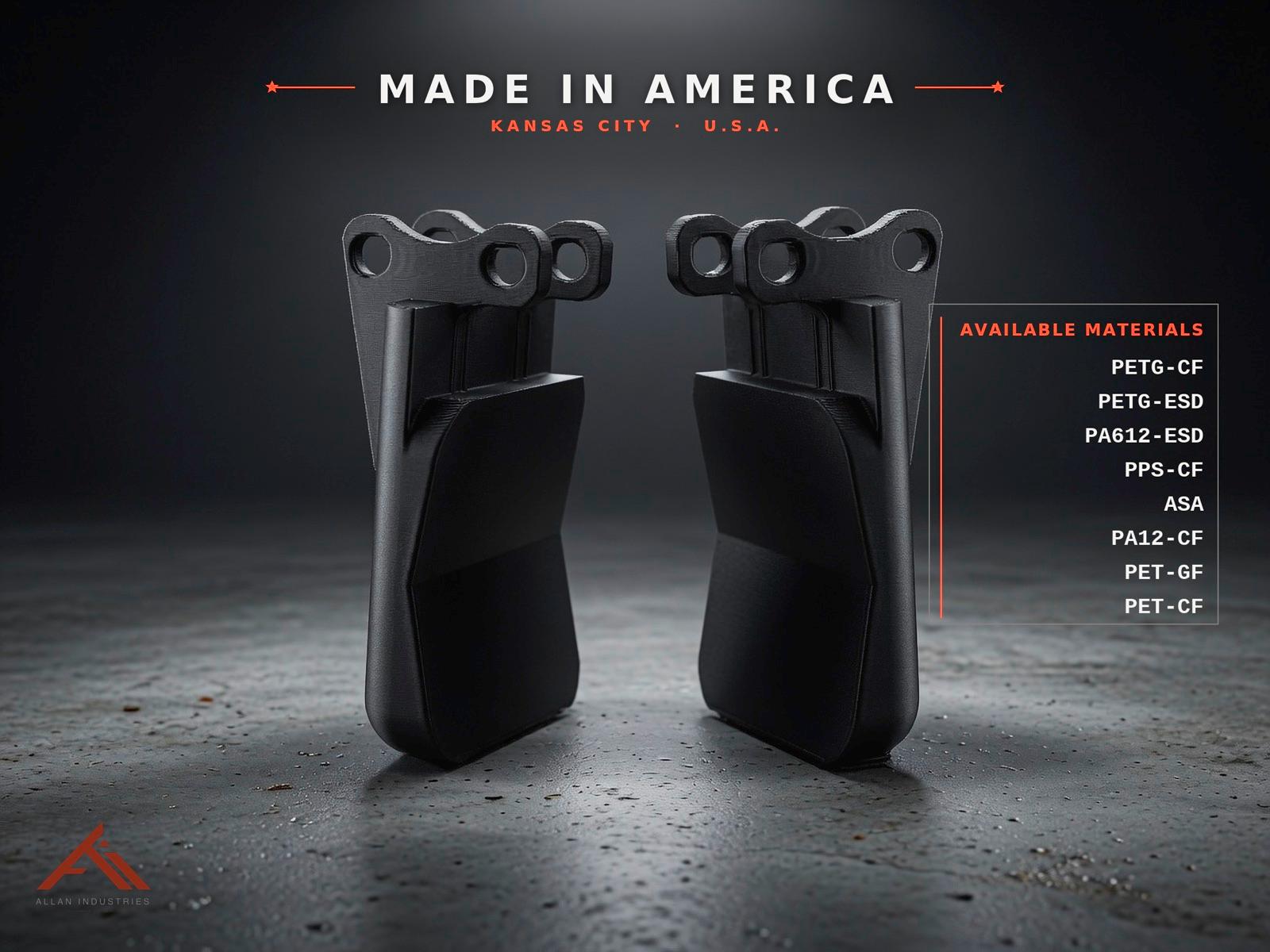
Machined aluminum EOAT eats your payload budget, slows your accel and decel, and turns every crash into a capital event. A printed end-effector does the same job at a tenth of the weight — and when it breaks, the file is the spare part.
Weight saved on the end-effector is capacity returned to the robot — bigger parts on the same arm, or the same parts on a smaller, cheaper robot.
Accel and decel are limited by what the robot carries. Cut the tooling weight and the same program runs faster — or the same cycle runs gentler, for longer robot life.
When a machined-aluminum gripper crashes, you’re waiting on a toolroom rebuild. When a printed one crashes, it’s reprinted overnight at a fraction of the machined cost, and the line runs in the morning. Design the tool as the fuse: the gripper breaks so the robot doesn’t.
These are published engineering case studies from the industrial FDM literature — their numbers, not ours. We cite them because the application is proven; we build the same classes of tooling in the same classes of material, locally.
Waterjet end-effector grippers. 35 lb → 3 lb. 85% time / 94% cost reduction vs machined.
Quick-change vacuum-gripper mount plates for high-speed packaging automation. 25% of the cost of their CNC-milled approach, running 80 pieces per minute with toolless changeover across four robots.
Conformal, part-specific jaws for robots and cobots. Non-marring on finished surfaces. Compliant geometries aluminum can’t get.
Custom cup layouts matched to your part geometry, printed as one piece with sealed, integrated air channels.
Lightweight end-of-arm tooling for press-side robots. See injection molding support →
Mounting plates to your changer spec, and sacrificial breakaway sections that protect the arm and the part.
Brackets, mounts, and dress-pack guides that ride the arm without stealing payload.
Hand-guide attachments, safety-edge covers, and quick-change fingers for high-mix cells.
Standard work runs PA12-CF and PA6-CF; polycarbonate where impact and clarity matter; PPS-CF where chemistry or heat gets serious. Anything bolted or clamped gets metal in the bolt path — heat-set inserts and compression limiters — so preload runs through steel, not creeping polymer.
And we’ll tell you no when polymer is the wrong answer: long cantilevers under sustained load, precision reference surfaces, anything where steel’s stiffness is the actual product. A tool that fails at your customer’s line costs us more than the order.
Send the STEP file or a photo of the tooling you’re running today. We’ll come back with weight, price, and lead time — typically same day.